
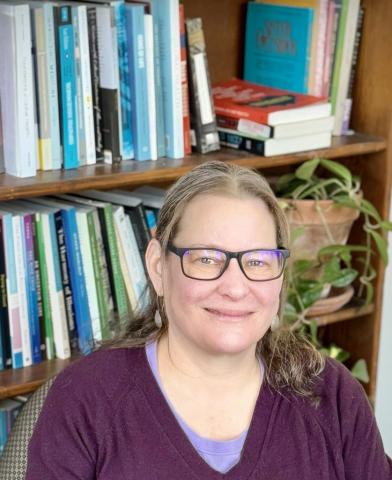
Erin Koch [Air-in] [KaWtch]
Research Interests & Expertise:
Agriculture, community & health; Plant and soil health; microbial relationships; infectious diseases; medical and health anthropology; Feminist Science & Technology Studies; multispecies studies; the Commonwealth of Kentucky; the United States; Eastern Europe and Eurasia.
As a cultural anthropologist I am broadly interested in agriculture, health ecologies and systems, and cultural and political aspects and relevance of science, technology & medicine. My current research explores relationships between agriculture, community and health in Kentucky and in the United States. I am working with local small-scale produce farmers and local organizations to understand the experiences and expertise of farmers and growers in relation to agriculture, food, soil, plants and microbiota. This engaged anthropological research also (1) aims to understand the health challenges and needs of local farmers and growers around health and support them, and (2) contribute to building healthy local communities, economies and agricultural systems. I am also interested in the experiences and roles of Extension personnel and local researchers and scientists, and the practical and translational significance of plant, soil and social sciences for health and ecological wellbeing in Kentucky, where local and regional viability and disparity are deeply rooted in agricultural histories, ecologies, institutions and practices.
My previous research investigated responses to tuberculosis in Georgia following the collapse of the Soviet Union, focusing on the implementation of a global WHO-based protocol for TB control. My research investigated how Georgian service providers navigate changes in what counts as “expert knowledge,” and the actual versus expected results of a so-called technical solution for disease management that is at once cultural, political, and biological. In my book based on this project, Free Market Tuberculosis: Managing Epidemics in post-Soviet Georgia, I examine cultural, (micro)biological, and political aspects of TB control in Georgia. I examine how contemporary global health standards for TB control multiply and reproduce the very disease they are designed to combat. Free Market Tuberculosis provides important and novel anthropological insights about infectious disease, human-microbe relationships, global health paradigms and interventions, and postsocialism. The book received the 2011 annual Norman L. and Roselea J. Goldberg Prize for the best project in the area of medicine (Vanderbilt University Press) and the 2014 Davis Center Book Prize in Political and Social Studies for an outstanding monograph on Russia, Eurasia, or Eastern Europe in anthropology, political science, sociology or geography (awarded by ASEEES).
In Georgia, I have also studied health effects of displacement among populations forced to flee their homes during civil war. I worked in a small city in western Georgia near the Abkhaz border to investigate the clinical, state and NGO administrative aspects of health needs assessment and service distribution. Published and in-progress articles based on that research address how global health and humanitarian interventions produce moral claims about displacement and health to organize institutions, diagnoses and social spaces as they bring relief--and distress--to social displaced populations.
Selected Grants, Fellowships and Awards:
- Association for Slavic, East European, and Eurasian Studies, Davis Center Book Prize in Political and Social Sciences, 2014.
- Vanderbilt University Press, The Norman L. and Roselea J. Goldberg Prize for the best project in the area of medicine, 2011.
- The University of Kentucky Alumni Association Great Teacher Award, 2011
- The National Council for Eurasian and East European Research (NCEEER)“Humanitarianism as Politics: Internally Displaced Persons, Health, and Citizenship in the Republic of Georgia” Principal Investigator, Collaborative Research Contract (with Elizabeth Dunn, University of Colorado Boulder), October 1, 2009-September 30, 2011
- The International Research and Exchanges Board (IREX)“Health Effects of Displacement in post-War Georgia.” Short-Term Travel Grant, summer 2009
- Graduate Faculty of Political and Social Science, The New School for Social ResearchStanley Diamond Memorial Award in the Social Sciences. PhD Commencement Award, Graduate Faculty of Political and Social Science, April 2005
- Columbia University, The Harriman Institute for Russian, Eurasian and Eastern European Studies Postdoctoral Fellowship, 2004-2005
Courses Taught and Teaching Interests:
- ANT 101: What Makes us Human? Introduction to Anthropology
- ANT 160: Global Cultural Diversity
- ANT 220: Introduction to Cultural Anthropology
- ANT 245: Food, Culture & Society (Fall 2026)
- ANT 251: Global Health Inequalities
- ANT 301: Histories of Anthropological Theory
- ANT 302: Ethnographic Methods: Doing Anthropology
- ANT 329: Anthropology of Eastern Europe and Eurasia: Socialism and Post-Socialist Change
- ANT 429: Survey of Medical Anthropology
- ANT 601: Culture & Power
- ANT 610: History of Theory in Anthropology
- ANT 646: Global Health: People, Institutions and Change
- ANT 724: Anthropology of the State
- ANT 770: Biomedical Cultures and Power
- HON 251-006: Cultures of Science, Technology and Medicine (Fall 2017)
- HSP 499: Health, Society, and Populations Capstone
- Community, agriculture & health
- medical anthropology
- Science and Technology Studies
- Plant and soil sciences
- Anthropology of Microbes and Microbiota
- Infectious Diseases
- Multisensory Ethnography
- global health
- Anthropology of the State
- Anthropology
- Health, Society and Populations
- Diversity and Inclusion
- Social Theory